In short: Choosing the best vacuum backpack for travel comes down to five things you can verify yourself: whether it passes a carry-on sizer when expanded, whether the pump is included, whether it works as an everyday bag, whether the compartments are genuinely separate, and how long you get to decide.
By Emily Carter, Travel Gear & Packing Expert · Last updated: 08/29/2026
The category grew fast, and the listings all read the same
According to a 2026 field review by Fluxis Travel Gear, the vacuum backpack market went from three brands in 2022 to seventeen in 2026.
Read enough of those listings and the feature lists blur together: expanded capacity in litres, a sealed compartment, a USB-C pump, a TSA lock, a laptop sleeve, a wet-dry pocket. Every brand leads with the same six things.
That is a problem for shopping, because a ranked list built on those six things tells you almost nothing. The differences that decide whether a pack works for you are more specific, and most of them are measurements rather than features.
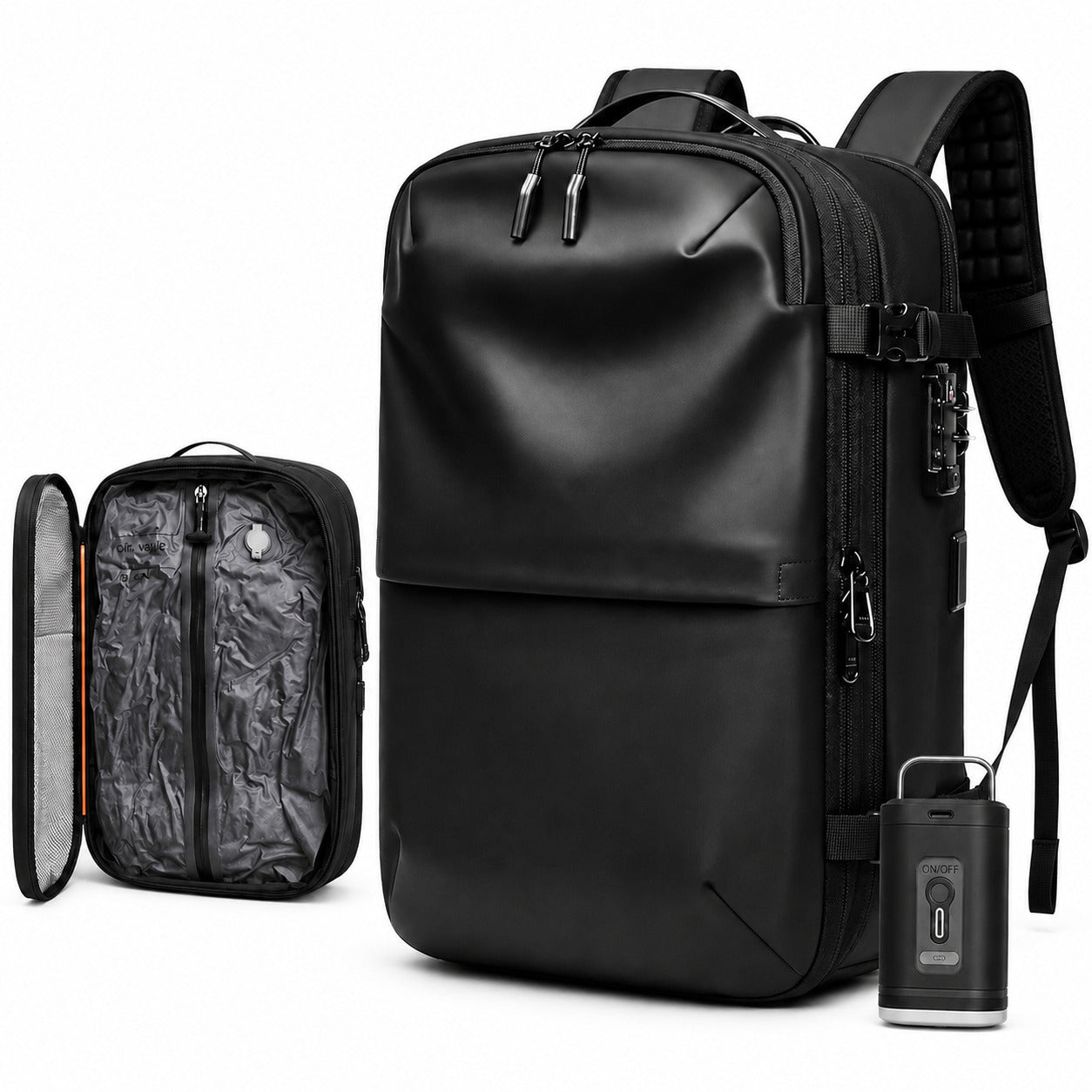
Best vacuum backpack for travel: what to check before you buy
- Whether it passes a sizer when expanded. This is the one that catches people. A backpack that fits the bin at 25L may not fit at 60L. Check the expanded dimensions, not the daily ones, and check them against the carrier you fly most. The FAA notes that airlines set their own carry-on limits, commonly around 45 linear inches.
- Whether the pump is included. Several listings advertise the backpack at one price and sell the pump separately. Consumer Reports found one popular model where buying the pump alone meant adding a bundle to the cart and deleting the backpack from it. Compare the price of a working setup.
- Whether it works when you are not travelling. A 60L pack that only makes sense on a trip sits in a closet fifty weeks a year. One that collapses to a daily commuter size earns its space.
- Whether the compartments are actually separate. Some packs are one cavity with a sealed pouch dropped inside. Others give the laptop, the tech, and the wet gear their own zones. Check the laptop sleeve size while you are there, since 15 inches is the common ceiling and a 16 or 17 inch machine will not fit every pack in this category.
- How long you get to decide. A backpack reveals itself over two or three trips, not in the first unboxing. Check the return window and whether it starts at delivery, because that is the only way to find out whether the compression compartment fits how you pack before you are stuck with it.
The expansion problem nobody mentions
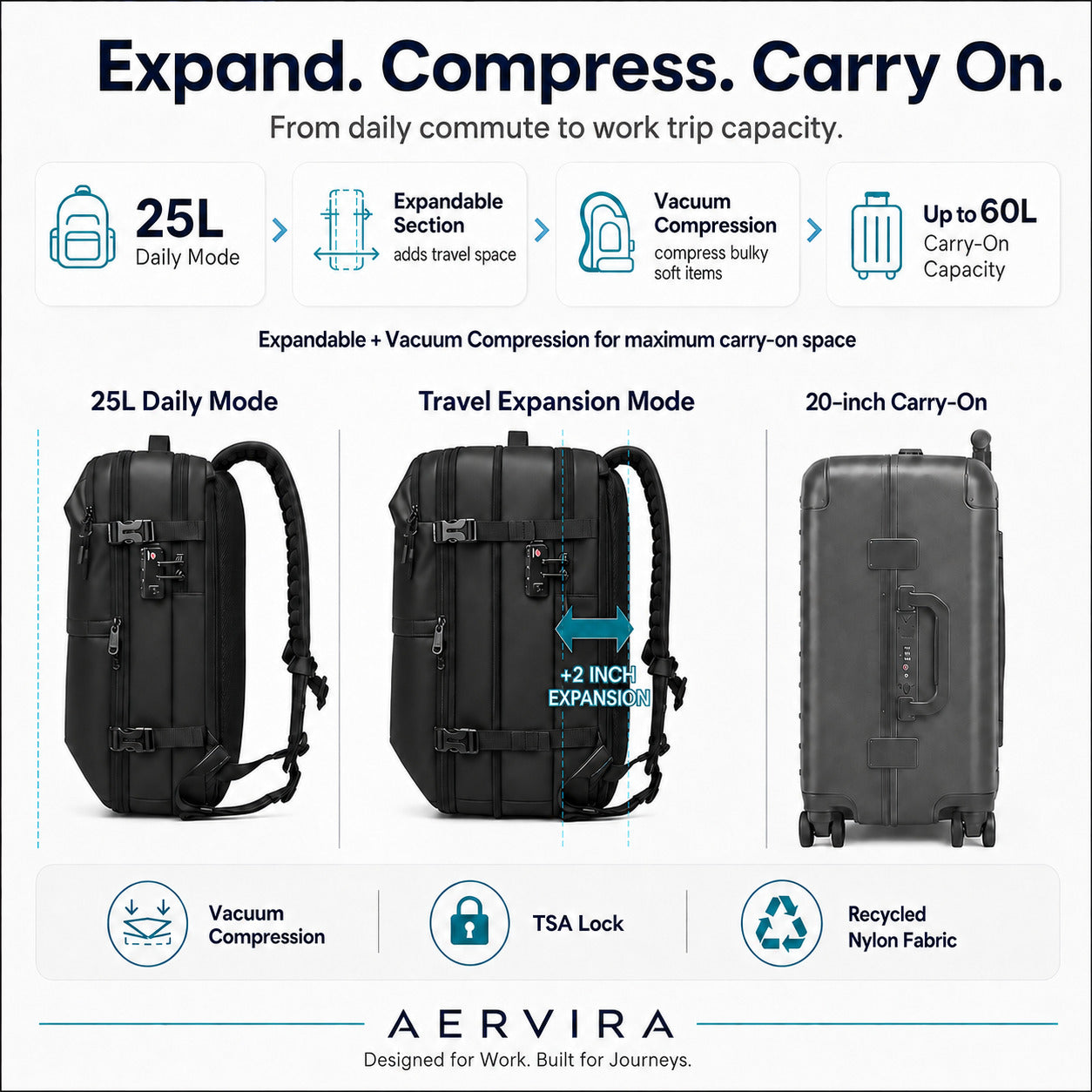
Most vacuum backpacks expand by adding depth. That is the cheapest way to build the feature and it creates the same problem in every brand.
A pack that grows outward in every direction becomes a different shape entirely, and carry-on sizers are rigid boxes. The packs that stay compliant are the ones where expansion adds depth along one axis while height and width stay fixed.
Before buying, find the expanded dimensions in the specifications. If a listing only gives you the daily size and a litre number, that is the answer to whether it was designed around a sizer.
Backpack or separate bags?
A built-in compression compartment and loose vacuum bags solve the same problem differently, and neither is strictly better.
| Vacuum backpack | Loose bags in a suitcase | |
|---|---|---|
| Compression | Fixed compartment, one zone | As many zones as you buy |
| Organization | Built in: laptop, tech, wet-dry | You supply it |
| Hands free | Yes | No, unless you already carry a pack |
| Flexibility | One shape, one capacity | Works in any luggage you own |
| Cost | Higher, it is the whole bag | Lower, it is an accessory |
A backpack suits you if you want one bag that handles the commute and the trip, you move through airports on foot, and you value having compression already built in rather than remembered.
Loose bags suit you if you already own luggage you like, you want to split clothes into several sealed groups, or you travel infrequently enough that a dedicated pack is hard to justify.
What a compression compartment does and does not do
It does flatten bulky soft clothing: hoodies, fleece, sweaters, gym kit, sleepwear, and worn laundry on the return leg. Winter layers benefit most because insulation is largely trapped air, covered in how to pack winter clothes in a carry-on.
It does not reduce weight. Compression removes air, and air weighs almost nothing. On international carriers that weigh cabin bags at the gate, freeing up space is a trap rather than a benefit. The arithmetic is in do vacuum bags reduce weight.
It does not suit structured clothing. Blazers, dress shirts, and tailored trousers crease along every fold, which is why the sealed compartment and the main compartment exist separately. Full breakdown in travel vacuum bags for clothes.
It does not help with shoes, toiletries, or electronics, because those have no trapped air to remove.
The airtight zipper is the part that fails
Across every brand in this category, the seal fails before the pump does, and the usual cause is filling the compartment past its line.
Two things follow. First, a new pack feels stiff on the first open, which is the seal working rather than a defect. Pull the zipper ring upward with steady pressure rather than yanking sideways. Second, if the compartment loses pressure overnight, check the track for a caught thread before blaming the valve. Diagnosis in why space saver bags puff back up.
Screening and the pump
The TSA allows vacuum-sealed clothes bags in carry-on and checked luggage, and the same applies to a sealed compartment inside a backpack. Officers may open one if it alarms, and they will not reseal it for you.
That is a stronger argument for a backpack than for loose bags, because the pump lives in the same bag as the compartment rather than in a suitcase you have already checked. Keep it in an outer pocket. Devices with lithium batteries belong in the cabin regardless. Full detail in are vacuum bags TSA allowed for carry-on luggage.
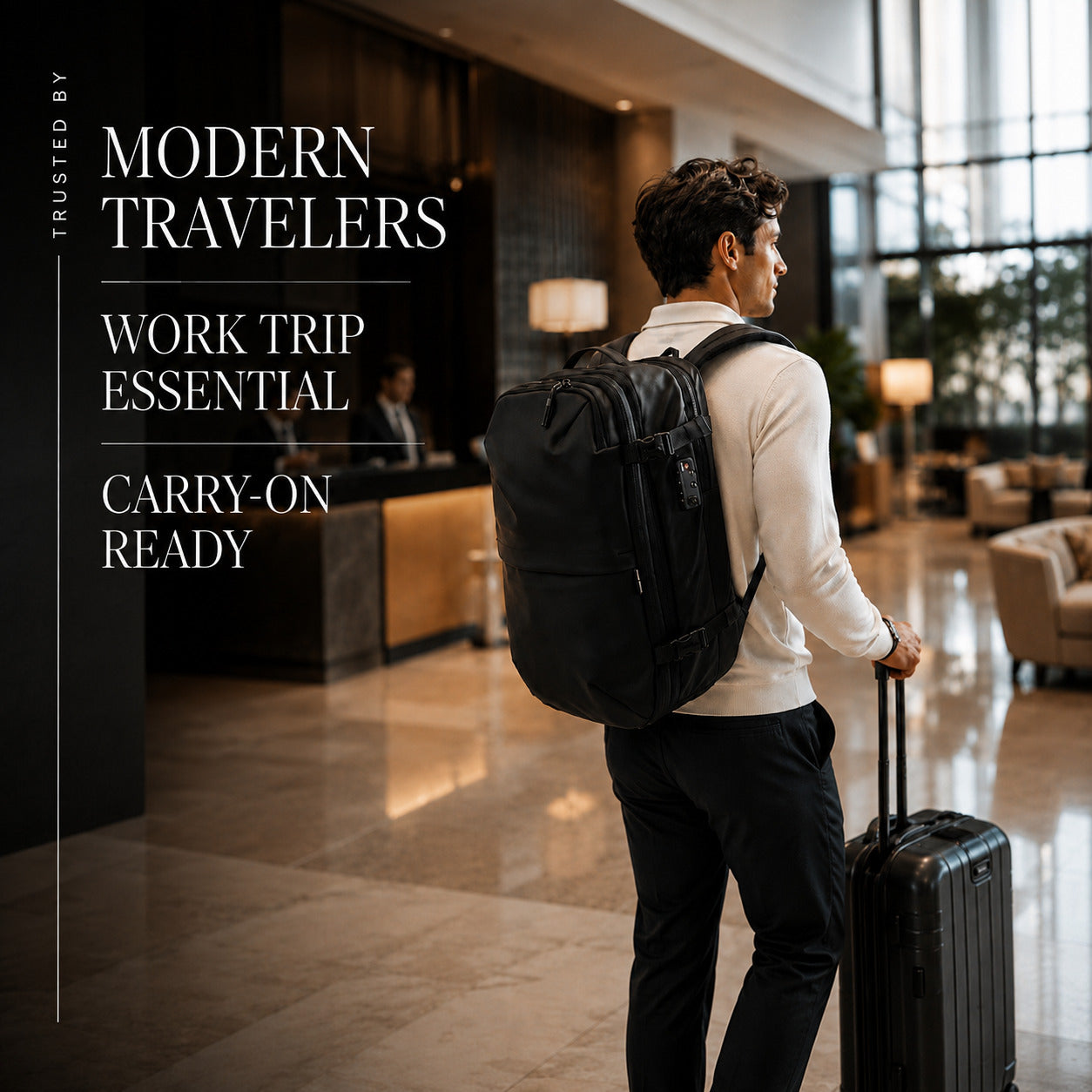
How the AeroPack answers each check
We make one of these, so treat this as disclosure. Here is the Aervira™ AeroPack 60L against the five checks above, with the numbers you can verify on the product page.
Expansion along one axis. Daily mode is 19.3 by 12.5 by 6 inches. Travel mode is 19.3 by 12.5 by 8 inches. Only the depth changes, so the pack gets thicker rather than taller or wider. That is the design described earlier as the one that stays inside a sizer, and it is why the AeroPack fits standard US carry-on limits in both modes rather than only when collapsed. Soft-sided bags bulge when fully loaded, so budget and regional carriers with tighter sizers are still worth checking.
The pump is in the box. No separate purchase, no bundle to unpick in a cart. It is USB-C and small enough for an outer pocket, which matters after a security inspection.
It works on the days you are not flying. At 25L collapsed it is a commuter backpack with a 17 inch laptop sleeve, which is larger than the 15 inch sleeve most packs in this category fit. A 60L pack that only makes sense on a trip spends most of the year in a cupboard.
A 100 day return window. That is long enough to take two or three real trips before deciding, which matters more than a spec sheet when the thing you are testing is whether a pack suits how you actually travel.
Separate compartments, not one cavity. Sealed compression zone, laptop sleeve, wet and dry pocket, tech and document pockets, and a luggage pass-through strap. The compression compartment is for soft bulky items. Structured workwear stays flat in the main compartment, which is why both exist.
What it will not do is escape the physics in this guide. It does nothing for weight, nothing for a blazer, and nothing for shoes.

FAQ
What should you look for in a vacuum backpack?
Expanded dimensions against a carry-on sizer, whether the pump is included in the price, whether it works as an everyday bag, and the return window. Suction ratings are not useful, since most brands publish similar figures.
Do vacuum backpacks fit as carry-on when expanded?
Some do, some do not. Expansion that adds depth along one axis usually stays compliant. Expansion in every direction often does not. Check the expanded dimensions rather than the litre figure.
Is a vacuum backpack better than vacuum bags in a suitcase?
Neither is better. A backpack gives you one bag with organization built in. Loose bags give you more sealed groups and work with luggage you already own.
Can you use a vacuum backpack without compressing anything?
Yes. The compartment is optional, and most packs work as ordinary backpacks with it unused. That flexibility is part of what makes a pack worth carrying year round.
Does the pump have to go in the cabin?
Yes, if it has a lithium battery. Battery devices belong in the cabin, not the hold. Keep it in an outer pocket so you can reach it after a security inspection.
In Short
- The category grew from three brands to seventeen, and the listings all lead with the same six features
- Check the expanded dimensions against a sizer, not the daily size
- Confirm the pump is included rather than sold separately
- The airtight zipper fails before the pump, and overfilling is the usual cause
- Compression frees volume, never weight, which matters on weight-limited routes
- A pack that collapses to a commuter size gets used year round rather than seasonally